Robert Colt, actor and acting coach, Los Angeles

The Art of Not Acting

Robert
Colt

Stop performing. Start living truthfully.

Study with Robert

Philosophy

The Art of Not Acting

Robert Colt reading from a book on stage, black and white, deep in concentration
On stage, 1990s.

I look at acting the way I look at life. Life unfolds moment by moment — unplanned, unpredictable, spontaneous. On the deepest level, life lives itself through all its forms. And on that same deepest level, as an actor, you get lived. You get played. What emerges spontaneously and honestly between the actor, the writing, and the fellow actors they’re working with — that is the work.

I believe the mind gets in the way — in both life and acting — of vibrancy, aliveness, and genuine response to what is actually happening. There is nothing more captivating than living truthfully. And by truthfully, I don’t mean socially accepted or conventional behavior. Acting becomes a true art form when the circumstances are fully inhabited — honored completely, lived spontaneously and unpredictably.

For me, Marlon Brando is the Buddha of acting. He is so present with what is, that in an intense and volatile scene with Blanche, he’s picking feathers from the air. And in On the Waterfront, when he finds his brother Charlie dead on a meat hook — most actors would be getting emotional. He simply walks to his brother, puts a hand on the wall, and drops his head. That is a living painting. A Picasso. A Van Gogh. A Monet.

My approach is not a technique you apply — it is a way of being you step into. It asks something far more demanding than learning a method or hitting your marks. It asks for courage. The courage to not know. The courage to stand in the fire of a scene without a plan, without a net, and trust completely what the moment calls forth.

Most actors are taught, in one way or another, to manage their performance — to shape it, control it, deliver it. This approach dismantles all of that. Because life doesn’t manage itself. Life erupts. Life surprises. Life moves through you before your mind has a chance to intervene. And that is precisely what an audience recognizes as real — not the performance of an emotion, but the unguarded arrival of one.

To work this way is to treat acting as a living art form in the fullest sense. The scene becomes an event that has never happened before and will never happen again. The other actor is not your scene partner in a rehearsed exchange — they are another human being, in this moment, doing something you cannot predict. The writing is not a script to be executed — it is a world to be inhabited, breathed into life, honored with your full presence.

When that happens, something extraordinary occurs. You stop acting and start living. And an audience doesn’t just watch that — they feel it in their bodies. They lean forward. They hold their breath. Because they are in the presence of something true.

That quality is not a gift reserved for the few. It is available to any actor willing to release control and trust what unfolds. This is the most direct, alive and exciting way to work — because it goes straight to the heart of what acting is for. Not to impress. Not to demonstrate. But to live, truthfully and fully, inside the greatest human stories ever written.

That is acting at its highest. That is the art of not acting.

The Journey

Forty Years in the Fire

I grew up in show business. My mother was a famous Burlesque dancer. In 1963, when I was three years old, I was taken on stage in the finale of Ann Corio’s show “This Was Burlesque” at the Gaiety Theatre on 12th Street and 2nd Avenue in New York City. Lee Strasberg’s Actors Studio actors would sit in the balcony — Lee sent them to study the great burlesque comics of that time and their impeccable timing in comedy.

I was in the wings catching wardrobe from strippers when I was seven and working the spotlight when I was twelve. On weekends the shows would end at 11pm or midnight and the cast would go out for “night lunch” — I’d eat silver dollar pancakes and laugh the whole time with the comics. It wasn’t until years later that I realized how much I had absorbed by watching and being around those great comedic geniuses.

Robert Colt, early 1980s headshot, black and white
Robert Colt, early 1980s.

My passion growing up was sports. I played varsity basketball at John Adams in Queens. Two knee injuries at sixteen changed my path, and by senior year I was headed to Eckerd College in Florida to be a sports writer. And then the first of two interesting twists happened. I took an elective — “Welcome to the Theater” — and auditioned for a talent night doing impressions: Muhammed Ali, Jimmy Cagney, Dusty Rhodes. The theatre had a balcony. I got a standing ovation. From that moment on, at 18, I was hooked.

The second twist and the real turning point was seeing The Deer Hunter in 1978. I couldn’t believe what I was watching. It was Robert DeNiro’s performance that blew me away most. When the film ended there was silence in the theatre. After a few moments I turned to my roommate and said:

“That’s it. I quit. I’m leaving college. I can do that. I just know I can do that.”

True to my word I finished out the semester and went to New York. I didn’t know what I was doing but I knew I wanted to be an actor and a great one at that.

I was working at a gym in Chelsea as a trainer — I’d worked in my first gym at age fifteen, and I loved empowering people. One day I walked over to help a client on the curl machine. When he finished his set I said, naively confident: “My name is Robert Colt and I’m going to be one of the best actors of my generation.” He smiled and said, “You need Warren Robertson.” Then he introduced himself: Michael Gore. He’d written the music for Fame.

So I was off to Warren Robertson’s Theatre Workshop, which became my new acting home. I loved it. I lived it, I breathed it. All I could do was think about acting, 24 and 7. One of my classmates at the time was the gifted Viggo Mortensen. We were very close, and he generously introduced me to his manager — who also represented Christopher Walken, Eric Roberts, Peter Weller, and Sissy Spacek. Casting directors were comparing me to a young Marlon Brando and Robert DeNiro.

February 1982

Then came the haymaker of haymakers. Cancer.

I had my major surgery and chemo treatments scheduled around my Wednesday night class at Warren’s, and I only had to miss one. That’s how dedicated I was and am. To this day I’ve never missed teaching one acting class, for any reason, in over ten years. But it would take me three years to recover my energy from the surgeries and chemotherapy. I lost the momentum and excitement in the industry that had been building. My manager let me go during my second chemotherapy treatment — via a phone call in the hospital. I found myself at ground zero.

What the cancer taught me — and what I didn’t understand until years later — was the functioning of the brain and nervous system’s survival mechanism. Before the cancer I felt fearless. After, I became filled with fear. Fear of my own mortality. It shook me to my roots. And it would take years of deep inner work to understand what that fear was doing to my acting — and ultimately, how to help other actors who carry the same thing.

What followed was twelve years of studying with some of the finest teachers in New York. Sharon Chatten — where I was alongside Vincent D’Onofrio and Ben Stiller. Vincent was the most extraordinary actor I had seen at that point. He was inspiring to watch. Bill Esper for two years and his third year master class. Wynn Handman, whose uncanny ability to give me roles pushed me past my limitations — including Mikel in Tovarich, a Russian character in a farce that Wynn had given out for over twenty years. He said my version was the best he’d ever seen. We went on to do several readings, including one at a full house in the United Nations. At the reception a lovely Russian woman came up to me and said, “I’m madly in love with you. Are you White Russian?” I told her I was from Brooklyn. She wasn’t happy about that.

From working with all these teachers, I learned an important truth: there are two things a teacher has to have. One — can they teach? Not all teachers can. The second — can they teach me? They have to be the right fit. That connection became one of the most important factors in my life as an actor and as a teacher.

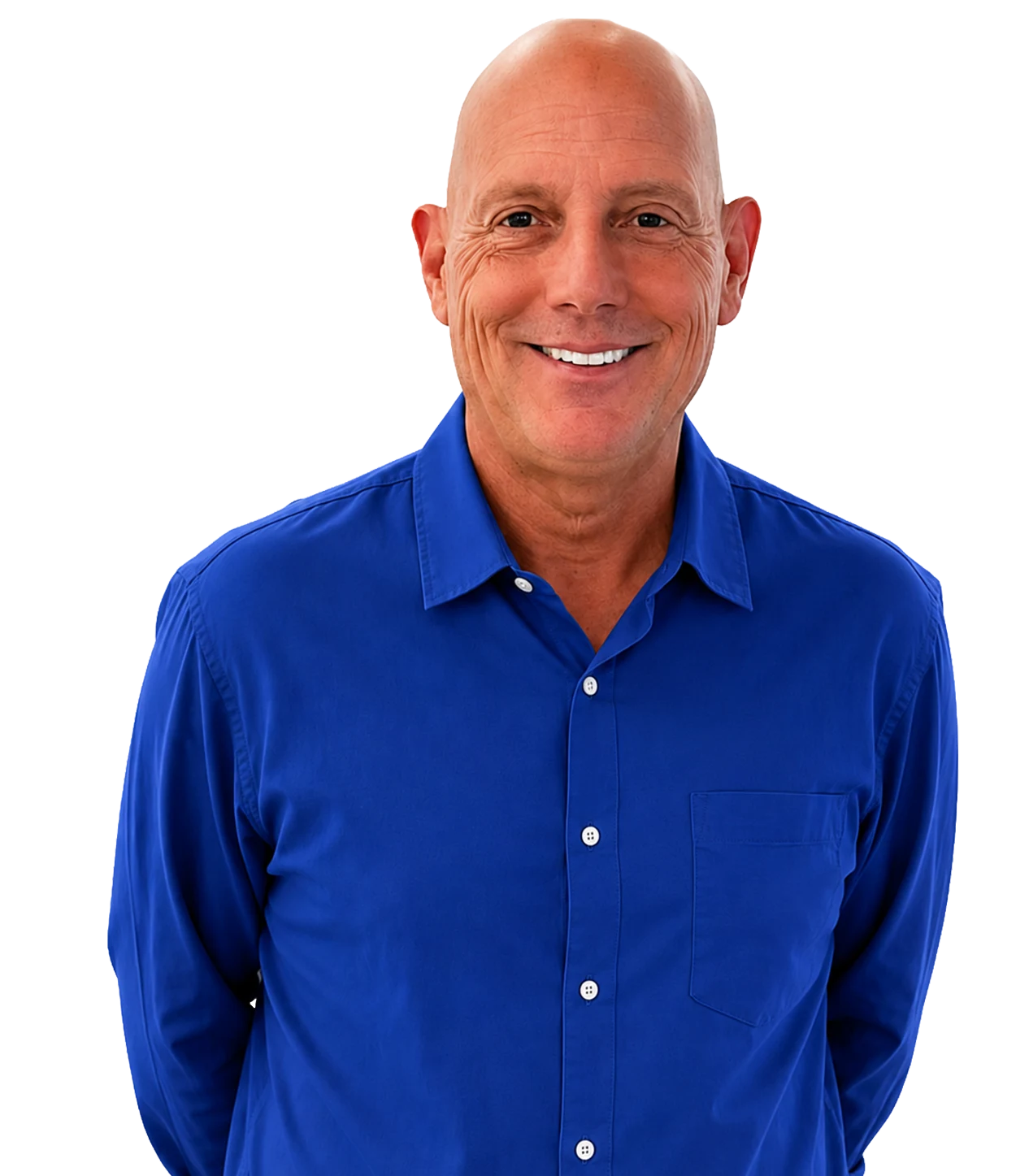
Robert Colt in a blue shirt, hands clasped, smiling warmly
Present day.

The fit happened when I met the late, brilliant pioneer Harold Guskin. It was the first time in my life that I felt respected and empowered at the deepest level as an actor. He did it immediately. You could feel Harold’s love for actors.

After my first session, he looked at me and said:

“You should be working all the time.”

The confidence that instilled in me I could feel in my bones. He planted a seed that day in his apartment on Jane Street that profoundly affected my life to this day. With Harold I realized the power of what I now call the genuine response — which went on to become a cornerstone of my classes.

Harold wrote a brilliant book I recommend to every actor: How to Stop Acting. He passed away in 2018. On his desk was a small piece of paper in his handwriting with his favorite quote: “A teacher affects eternity; he can never tell where his influence stops.”

Alongside my training as an actor, I’ve spent forty years in deep inner work — Advaita Vedanta, specifically the teaching of the great Indian sage Nisargadatta Maharaj, Kashmir Shaivism, Zen, and seventeen years studying Quantum Psychology with Stephen Wolinsky, the founder of that field. This understanding of the brain and nervous system is not separate from my teaching — it is the teaching. It is why I can help actors unblock, get out of their own way, and live a full creative life.

Guiding actors is a rare privilege. I use the word “facilitate” rather than “teacher” because when I work with actors in class or privately, I experience it as collaborating in universal truths presented by the given circumstances of great writers. It’s an extraordinary process of discovery and exploration that requires the willingness — not to know — both by myself and the actors I work with. When you have the courage to explore in this way, it changes your life as an actor and as a person.

The Work

Classes & Private Coaching

Scene Study — Group Classes

Weekly scene study classes, open to actors at all levels who are serious about the work. Based in Los Angeles.

The class is not a workshop or a seminar. It is a working room. We bring material — great writing, scenes that demand something real — and we go into them without a net. Actors bring their best preparation and then let it go, because preparation is not performance. What happens in the room is what matters.

“I’ve never missed teaching one acting class, for any reason, in over ten years.”

Schedule details coming soon — contact Robert to inquire.

Private Coaching

One-on-one sessions built around where you are right now: an audition, a role you’re developing, a pattern that keeps getting in your way. Available in person in Los Angeles and via video.

Private work tends to go deeper and faster than class, because there is nowhere to hide and no one else to watch. What happens in a private session is between you, the material, and the truth of the moment — with Robert as a guide who has spent forty years learning exactly how to get out of the way.

Robert Colt, direct gaze

Robert Colt, creator of The Art of NOT Acting — a no-bullshit approach to helping actors stop performing and start living truthfully in every scene.

— A student

Lineage

Who He Studied With. Who He Studied Alongside.

Teachers

  • Warren Robertson — Theatre Workshop, New York (1980s). Where Robert first truly lived the work.
  • Sharon Chatten — Method. In that class: Vincent D’Onofrio, Ben Stiller.
  • Bill Esper — Meisner Technique. Two years plus third-year master class.
  • Wynn Handman — Two years. Tovarich at the United Nations.
  • Harold Guskin — Author of How to Stop Acting. The transformational fit. Jane Street.
  • Stephen Wolinsky — Quantum Psychology, Advaita Vedanta. Seventeen years.

Peers & Contemporaries

  • Viggo Mortensen — Classmate at Warren Robertson’s. Close friends.
  • Vincent D’Onofrio — Classmate at Sharon Chatten’s. “The most extraordinary actor I had seen at that point.”
  • Ben Stiller — Classmate at Sharon Chatten’s.

Industry Recognition

  • Managed by the same representation as Christopher Walken, Eric Roberts, Peter Weller, and Sissy Spacek.
  • Casting directors compared him to “a young Marlon Brando and Robert DeNiro.”

Connect

Begin

To inquire about classes, private coaching, or to learn more about studying with Robert, get in touch.

Or email directly: robert@robertcolt.com